Sunday, August 25, 2013

Ki kati!

Well, university strikes aside, I am one week down in data collection here in Uganda!

Tuesday morning I hiked back over to Mulago Hospital to meet with the lecturer with whom I had been corresponding and then with the head of the anatomy department; we had a good chat about my work and the university strike. The department head seemed a little hesitant to let me start, but all of the technicians were in the building despite the strike, so he introduced me to the staff and had the chief technician help me get started. The chief technician (mainly an embalmer, I believe) is the one who pulls specimens out of storage for me. He is a lovely mild-mannered middle-aged gent with five kids, and he is very patiently teaching me phrases in Luganda (the language of the Baganda people, one of the biggest ethnic groups in Uganda), which is spoken much more widely than Swahili here.The Galloway Osteological Collection, as it is officially known, is in fairly good shape overall, although some of the individuals are missing random elements (rather typical, for a dissection cadaver-based collection). What bones are there are generally complete with little breakage, which is a welcome change after the state of most of the archaeological collections I dealt with in Peru. My workspace is a room tucked between the cold lab where the donated bodies go for embalming before dissection and the storage area for all the skeletons. The technicians and lecturers tend to wander in throughout the day to see how I'm getting along; everyone is super friendly and asks me questions like "How are the States?" I admit I was initially stumped on how to succinctly describe what it's like to live in America. I finally settled on "expensive."  They also all tend to be very concerned that I'm not eating enough for lunch - I generally pick up a samosa and piece of fruit or such from the cantina to have along with my Clif bar, while they are all eating huge plates of rice and meat and matoke. I promise them I'm eating big dinners in the evening and am just having a small lunch to maximize my time for data collection, but thus far they remain unconvinced.

I am able to work fairly long hours throughout the week with the collection (around 8a-6p), so I haven't been more ambitious than showering and having dinner in the evenings. Either at breakfast or dinner, though, I've met several people staying at the guest house, including William (a young Irish law student at Cambridge) and Espern and Mette (two Danish colleagues, a social scientist and political scientist, respectively). Espern and Mette have both been traveling to and working in Uganda for the past decade and so have provided a great introduction to some local places.

Friday night, Espern convinced us to accompany him to Club Obbligato to hear Afrigo Band play; they are a large group of musicians with a few dancers who play shows there every Friday and Saturday around midnight. Given Espern’s description that the place could get “a bit rough” I wasn’t quite sure what to expect – there was a guard with an AK47 out front, we paid the entrance fee and then entered a covered outdoor patio with a large stage, central area for dancing, and tiered levels of tables and chairs. Contrary to my expectations of a crazy, riotous packed dance club, however, the place held a crowd of mostly 30- and 40-somethings calmly seated, enjoying beers, and waiting for the show to start.  The music was mostly traditional Swahili, which is very fun and upbeat, with some great complicated rhythms. Before long, Espern was jamming in his seat and soon pulled all of us up to join the others already on the dance floor. All in all, a great time.

Oldest stone tool (2 mya) in Uganda
On Saturday I decided to head out and finally explore the city of Kampala a bit. I went to the café around the corner on Wandegeya that is supposed to have internet but again did not, so had just a snack instead and then continued on to the National Museum, which is just about half a mile down the road past where I work at Mulago Hospital. The museum has an interesting collection of musical instruments froth century. There were even a few small cases about human evolution in East Africa, complete with hominin fossil casts.
m all over East Africa, as well as some displays of the ethnographic and colonial history of Uganda itself. One of the parts I really liked was the display of official Olympics posters stretching back to the early 20

Made some Nepalese friends at the Independence Monument
I then walked the entire stretch of Kampala Road, starting from Bombo Road, all the way down to the City Center where it turns into Jinja road and then around to the Garden City area. I had lunch at what my guide book calls one of the best Indian restaurants in Kampala. It was definitely several levels up from the fare at the guest house! I did a little souvenir shopping at a store in the Garden City mall that has Ugandan handicrafts – a lot of touristy places focus on selling more generic Kenyan carvings, etc, and it can be a little harder to find cool stuff made in Uganda. This particular store is known for selling fairtrade goods, which is always nice to support. I then walked around a bit more to find the Independence Monument, where I met a couple of guys from Nepal. After walking all afternoon I decided to take my first ever boda boda ride (basically a moped taxi) back to Makerere. Boda bodas are a ubiquitous feature of East Africa, and I would be lying if I said they had a great safety record, but if you tell the driver to go slow and to not drive crazily, it's pretty reasonable.

Saturday night the guest house crew and I decided to go back to the club for some more music and dancing, and so we had another fun evening. The place was definitely more packed last night, but it still had a great relaxed atmosphere. As one of the workers at the guest house told us, it's a place you could take your mother without shocking her. Heh.

Today Espern introduced us all to yet another great feature of Kampala: the Kabira Country Club. For a small fee, you can pay for a day pass that allows you access to the pool, gym, sauna, etc. There is free wifi (hence this blog update!), a tasty restaurant, and plenty of comfy chairs for lounging. It rained all morning so I started with a workout, but after lunch the sun came out and it was absolutely lovely to relax by the pool for a bit. The country club is definitely quite different from the rest of the city and it honestly feels a bit colonial to hang out here - the place is full of expats, diplomats and their families, wealthy Ugandans, etc - but it is a good place to recharge.
Lovely pool @ Kabira
And with that, I'm off to finish my large piece of chocolate cake and do a bit of data formatting before returning to my regular non-country club lifestyle. I haven't had a chance to download pictures yet, so I will add those whenever I'm able. The entire university network has been down since Tuesday, and with the ongoing strike no one is fixing it, so I am sadly without wifi at the guest house and the medical school for the foreseeable future.

More Ugandan adventures to follow - hopefully next weekend I will visit the source of the Nile!  Cheers!


Monday, August 19, 2013

Crisis...averted?

You know, after Peru and the day I had yesterday, I was almost convinced that the first week of any data collection trip is meant to be cursed. I arrived in Uganda yesterday via London - Addis - Entebbe (aside - in the airport in Addis Ababa there is a small 4x4 booth where you can smoke INSIDE the airport. crazy), waited in line for my Ugandan visa ($50! sheesh), and then met my pre-arranged taxi to take me to Kampala (about a 45 minute drive). Once I arrived at the university guest house, I was in for two bits of "excitement:" 1) seems my online reservation didn't go through, so they had no idea I was coming and 2) seems Makerere University shut down the other day due to a strike over pay and the only thing currently open on the entire campus is the guest house. Gah!! Problem no. 1 was easily resolved because luckily there were a few open rooms in the guest house (basically a glorified dorm, but it's clean and has hot water, so I'm not complaining), but problem no.2 obviously threatened to derail my entire data collection plan for the next three weeks.

After an evening spent fretting and contemplating contacting the Kenya National Museum in Nairobi to see about getting a research permit there (generally NOT something that can be accomplished quickly), I eventually decided to send my sleep-deprived self to bed (I just can't sleep on redeye flights. sigh) and check on the status of the strike in the morning. In said morning (after a glorious 12 hours of sleep under the mosquito net), I remembered that the osteological collection is not, in fact, stored at the university but rather lives in the anatomy department of the medical school, which is located in nearby Mulago Hospital. So, I had breakfast (note to self: tomorrow hit the breakfast buffet earlier because the pickings are slim 20 minutes before it closes) and then decided to trek over to the hospital to see if the medical school was affected by the strike.

I had read online that the strike had led to an increased police presence on the university in case of riots, which was, shall we say, mildly disconcerting, but after seeing the police guards at the gate reading the newspaper and the others lolling about on the grass taking naps, I became much less concerned (this is another, sorry mom! moment). Everyone else seems to be going about their business as usual; people were playing tennis on the courts in front of the guest house, and I passed a huge line in front of the university registrar's office, which probably had something to do with the fact that classes were supposed to start today.

Great advice as always, Sus.
Anyway, I consulted the map in my travel guide and headed out, thinking the hospital shouldn't be *too* difficult to find. And it probably wouldn't be, if Kampala believed in street signs. Which, as far as I can tell, they don't. After wandering around for a bit and asking a city worker for directions (which helped a bit but not really), I eventually met a nice young physiology student from the university who drew me a map. In the heat of the late morning sub-equatorial sun, I continued my journey and eventually found the right building. Inside, one of the students called the person with whom I've been coordinating my visit, who very cheerfully welcomed me to Uganda and set up a meeting for tomorrow morning! So, fingers crossed I will get to start working with the collection tomorrow!!

After the expedition to the anatomy dept, I came back and had lunch at the guest house restaurant and then decided to take my advisor's advice: have a beer, relax, and work on data formatting.

Friday, August 16, 2013

And she's off! Again. :)

I know, I know - I promised we'd never be separated for so long again. But traveling just gets so hectic!

I started this post yesterday while installing and updating several programs on the laptop I will be using for data collection on the next leg of my journey. Yup. One of the exciting occurrences of the last couple of weeks is that my new cute little HP sleekbook refurb decided to start going wonky the day after I got back from Peru. Yes, yes - of course it is good that a) this didn't happen IN Peru and b) I had all of my lovely Peruvian data backed up. But still.

Puma fountain in Cusco.

View of the plaza from Compania de Jesus balcony
So, in terms of travel updates, I haven't even wrapped up my adventures in Peru yet! Last time I checked in, I had just finished my work in the gabinete, attended the symphony with Eliza, and had an abundance of pisco sours with my airbnb host Carlos and Tony the Scottish Psychologist. For my last weekend in Cusco I decided to stay in the city and visit some places there, including the two huge churches on the Plaza de Armas - El Catedral and Iglesia de la Compania de Jesus (the Jesuits decided to build their elaborate church just catty corner to the grand cathedral, apparently much to the consternation of the church officials there. The story goes that the guys at the Cathedral complained to the papacy while the Jesuits were building, but by the time they received a reply the Jesuit church was already finished - boat mail in the 16th century being reeeaaaalllly slow. So it goes.). There are some nice Escuela Cusquena paintings and woodwork in El Catedral, but I must say that overall I felt the admission price (which is double most other churches/museums in the city) to not really be worth it. I found La Compania to be more interesting because it has about a dozen elaborate altars, including an enormous gilt one at the front, and you can climb up a tiny staircase behind one of the altars to reach the balcony for amazing views of the Plaza and of the interior of the church.

El Catedral and the Plaza de Armas in Cusco, all decked out for Peruvian independence.

And the ornate nearby Compania de Jesus

View of El Catedral from la Compania de Jesus. Think the Jesuits sat there and privately but piously thought their bell towers were better? Cathedral wins for nice, raised platform, though.
I also toured this convent, the Monasterio de Santa Catalina, which had displays about the purposes of the different rooms for the cloistered nuns. The monastery was built on top of the Inca palace where the emperor kept the beautiful virgins who made his clothes. It then became a monastery where the nuns specialized in making priestly vestments...
Through Tony I ended up meeting some other great people in Cusco that weekend, including a filmmaker who knows lots of archaeologists and anthropologists all over South America (he even gave me some contact info for a curator of some skeletal material in Chile!) and some Aussie and Brit expats who congregate at Paddy's Pub. And after two months of bread and jam for breakfast, I finally had a free morning and Tony took me to Jack's, where I demolished a huge plate of eggs, bacon, sausage, toast, potatoes, beans, and avocado. Delicious.

Complimentary alfajores upon check-in @ Casa Ortiz

After bidding farewell to Cusco and heading back to Lima, I once again enjoyed the hospitality of Alejandra's family. There was even a box from La Confiteria waiting for me! As Alejandra explained to me at breakfast, "I want to feed you."

That night her parents and I went to the Parque de la Reserva, a huge park in Lima that has around 20 different fountains, just as it was starting to get dark, so all of the fountains were lit up. It was really very beautiful and a lot of fun to walk around and see everything (Alejandra's mom called multiple people later that night to tell them about it). Her parents kept thanking me for being there (which was funny because they paid for everything, so I kept thanking them) because it meant they actually got out and did touristy things. I of course can totally relate because I generally only do touristy things in NYC when people come to visit. So a good time was had by all! The iPhone pics below aren't the best but are still good for an overall feel of the place.
Fuente de la Vida

 Mama y Papa Ortiz: Fuente de la Cupula Visitable
Not quite sure what Ale and I are doing in this one...

Fuente de la Fantasia

Fuente Magica
We even rode the little train around the park!
We ended the evening with a trip to Barranco, a neighborhood that borders the ocean and has lots of fun little restaurants and shops. After visiting the Puente de los Suspiros (the Bridge of Sighs; apparently walking across hand in hand with your loved one is supposed to guarantee you a long and happy romance), we had coffee and snacks at a cafe and then strolled down to see the ocean.

For my last day in Peru, we took a short trip outside the city to the site of Pachacamac, a religious center built by the Huari and later subsumed by the Inca. There's a long path around the site you can either drive or walk to view the ruins of several large building complexes. One of the areas you can tour more closely; the path runs all the way around it for great views of the Pacific Ocean. After touring the site and watching the alpacas and Peruvian hairless dogs who live there, we returned to Lima for an early dinner at a cafe, and then I came home to nap and pack before leaving for the airport at 2am.
View of the Pacific from Pachacamac

Restored temples at Pachacamac
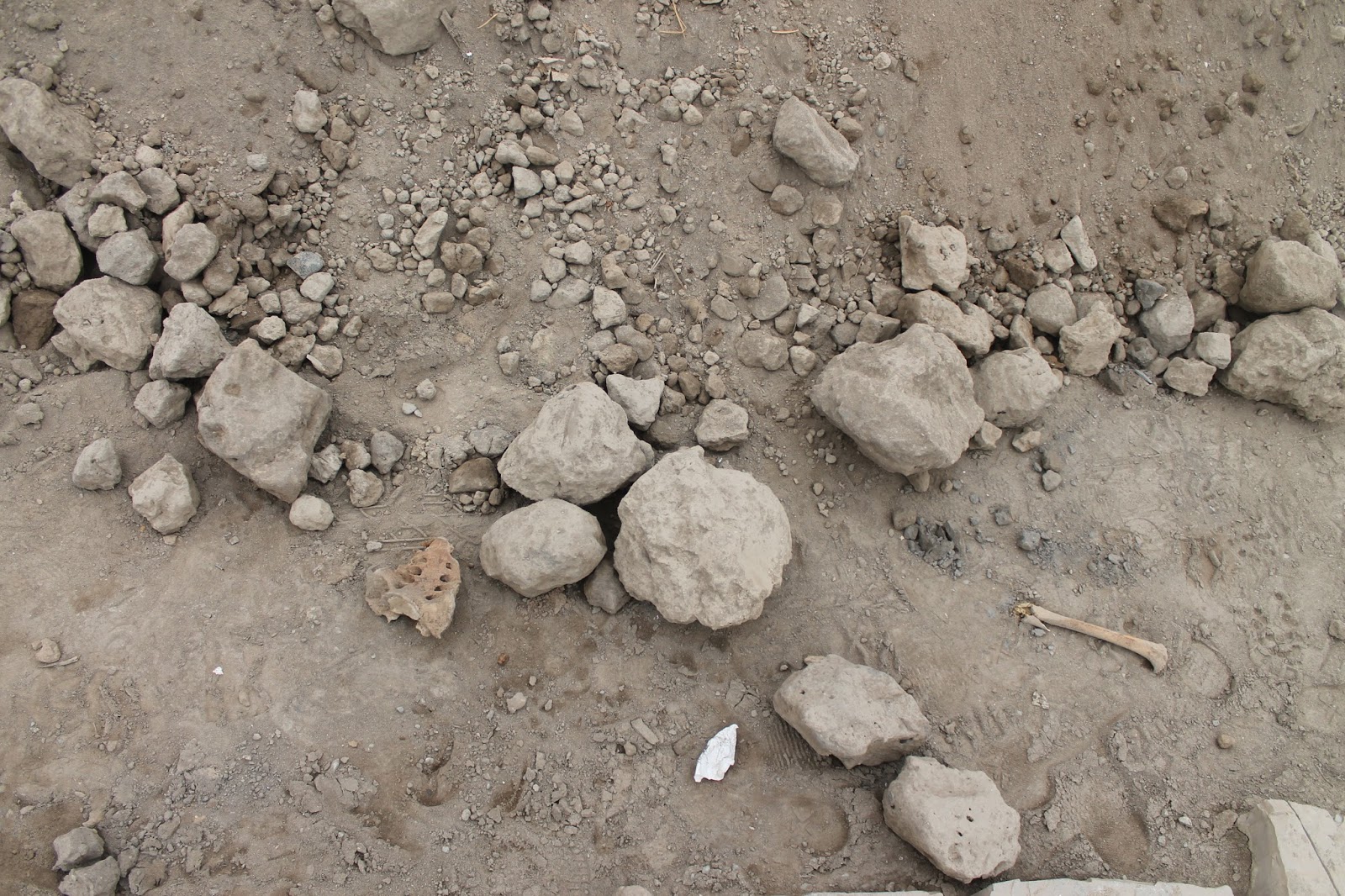
                          Yup. That's a human sacrum and juvenile tibia just sitting by the side of the visitor path.                    Whoever decided not to screen the excavating fill should be fired.

As I geared up to leave Peru, I realized that even though my Spanish is still pretty atrocious, I know enough to be able to understand and respond to questions about where I'm from, what's the composition of my family, what do I like about Peru, and other such conversational queries. I know this because in the 45 minute drive to the airport my taxi driver was apparently intent on learning my life story, and I was able to mas o menos share it with him. (Si, tengo una sobrina, y ella tiene doce anos!)

And so with a 5am flight to Panama City with connection to Newark, my travels in Peru were over! Leg 1 of the dissertation journey: complete! Excellent.

My two week interlude in New York flew by, as all such quick visits do when there are lots of people to see and plans to be made. But it was great to spend some quality time with Jeff and see a bunch of the NYU crowd before heading out again. Some fun highlights with the hubby included a trip to the Prospect Park Zoo, bar trivia night with Crainwater and Eva, a Yankees game with Jason, Susan, and LG, and dinner at a new restaurant in the old nabe with Maryjka and Josh. I spent the rest of the time agonizing over my laptop troubles, finalizing lots of travel deets for Uganda and London, and drinking beer with people at the pub. All in all, a great stopover in NYC. Except, even though in my head I knew it was just a stopover, it still came as a bit of shock when yesterday came around and it sank in I wouldn't be back until Christmas. Yikes. The ride to the airport was a little bittersweet, actually. But now I'm ready for the next stage in this dissertation adventure!

So, last night I took the red-eye to London. The woman on the plane next to me was literally touching up her french manicure as we landed. Seriously? Anyway, thankfully getting through immigration and customs didn't take that long (although I somehow got into a fairly drawn out conversation with the immigration guy about comparison grocery shopping - I'm sure the people in line behind me were NOT impressed, but it was totally not my fault! Jeff accuses me of having conversations with random people but I promise I generally do not initiate them. Although I do participate in them once they've begun. I guess I just look conversational. I dunno.) From the airport I grabbed the Hotel Hoppa bus to my airport hotel, and luckily I was able to check in right away. After, a nap, a run, and a soak in the hot tub I felt like a real person again and headed out to have dinner at the pub across the street - yay for fish and chips!

Which brings us to now! Tomorrow night I catch a plan to Uganda, where for the next three weeks I will be working with the collection at Makerere University. This is my first excursion to Africa (I know, I know - up til now I have been a total failure as a paleoanthropologist!), so I'm excited to see how this goes! Not sure about the internet situation where I'll be, but I'll update when I can. Thanks for the encouragement to keep writing, everybody!

Cheerio!

Sunday, July 28, 2013

Notchu Picchu, Machu Picchu! (I have no idea what that means)

Huzzah for Machu Picchu!  The day started with my alarm blaring at the unfriendly hour of 4:30 in the manana, followed by breakfast at 5, so that I could be standing in line to buy my bus ticket up to Machu Picchu by 5:30.  Now, the guidebook said there would be a line of people by about 5:15 since the buses start running at 5:30. However, the guidebook did NOT mention that that line would stretch down the street. Holy cow were there a lot of people. All told, I didn't actually walk through the gate of Machu Picchu until about 6:45 (and it's only a 20 minute bus ride up). Luckily, the sun didn't come up over the mountains until a little after 7, so I had time to climb up to the Gatekeeper's house for some prime sunrise viewing.


A llama decides to be postcard-scenic as the sun rises over Machu Picchu.
After the sunrise, I decided to do the hike up Machu Picchu Mountain that my slightly more expensive entrance ticket enabled me to. I had wanted to hike Huana Picchu, but that extra ticket was already sold out, so the Montana was kind of the consolation prize. An hour and fifteen minute hike up steep stone mountain steps consolation prize. After having done the Putucusi hike the day before, my muscles rebelled a little, but I eventually made it up to the top.

Stone doorway on the hike up Machu Picchu mountain

Machu Picchu looks so far away from the top of the mountain!

After enjoying the view from the top of the montana and hiking back down, I spent the rest of the afternoon walking around and visiting the rest of the ruins.


A pensive view of Machu Picchu.

Aguas Calientes
In the afternoon I sprang for the expensive buffet lunch at the fancy schmancy nearby hotel, spent a bit more time at the ruins (it was kind of nice to just hang out on a rock and take in the city in the sun), and then headed back down to Aguas Calientes to catch my train back to Cusco. My train ride back was in a slightly more expensive car than the trip there (hey, it was all that was left in the time spot I wanted), and it was quite a different experience than the budget train. Instead of just a snack, I was served a full-ish meal, and then came some true randomness. A guy in a jester suit with a mask danced up and down the aisles for a while, and then the serving crew put on a fashion show of for-sale alpaca sweaters and such to the sounds of blaring Andean music. If this wasn't strange enough, yours truly got pulled by the weird jester guy to the back of the train where I was pressed into said fashion show, in which I (reluctantly, but with good humor) modeled a baby alpaca hair poncho. Yep. A poncho.

Cool street drain in Aguas Calientes
Sorry, no pictures of the fashion show. Just the train.

On the train ride both there and back I ended up sitting next to psychologists (apparently there was a big international conference in Lima this past week and they were all taking whirlwind tours to Machu Picchu). When I told this to my airbnb host Carlos, he laughed and told me I had taken the "crazy train." Heh.

The gabinete crew: Juan, Eliza, y Elva
And, lest you think I've only been bouncing around ruins, here's a picture of the amazing trio at the gabinete de antropologia fisica with whom I have shared office space for the past month. The last two weeks have involved 9 and 10 hour days of work and so have been a little exhausting - but great in terms of getting a lot of data! The wonderful Elva even arranged an extra trip last week to the deposit where the skeletal material is stored so that I would have more bones to study. It was definitely sad to say goodbye to everyone on Friday; Juanito gifted me with a Quechua name: Qorichaska, which means something along the lines of "gold star."

Newly renovated entrance hall at the Cusco Teatro Municipal
On Friday night, Eliza invited me to a concert at the Teatro Municipal, which was celebrating its grand re-opening after being shut down by a fire two years ago. We had a little comedy of errors to get in - we went early and waited in line, only to be told they had handed out all of the free tickets already. So, we headed off to dinner and had just sat down at the restaurant when we got a call from Elva telling us they were letting people in without tickets. We literally ran back to the theater, managed to get in, and found some seats just a short bit before the concert started.

The Orquesta Sinfonica del Cusco was performing, with guest soprano Sylvia Falcon. She sings in the style of Yma Sumac, with an upper range that basically imitates a flute - pretty amazing. After a lovely concert consisting mainly of orchestral arrangements of traditional Andean and Peruvian music (it is, after all, the Fiestas Patrias weekend - today [July 28] is the celebration of Peru's independence), Eliza and I headed back to the restaurant for sushi and cocktails. I then headed back to Casa Carlos, where I joined my airbnb hosts and a couple of other guests for a cozy evening of pisco sours that lasted into the wee hours. All in all, it was a great evening to top off a month of data collection here in Cusco. Can't believe my time here is drawing to a close - I head back to Lima on Tuesday!

Qorichaska out.

Tuesday, July 23, 2013

Machu Picchu?! Nope. Still not there yet.

Aaaaaand she's back!

I've been meaning to include a short digression on public transportation in Cusco (it also applies to el norte de Peru) for a while now, so I'm going to lead off with that before picking up yesterday's thread again. When I talk about "taking the bus" perhaps what pops into your mind is a typical, large American-style public bus. Oh no no no, my friends. Down here in Peru, buses - also known as combis - are an entirely different animal. We're basically talking about something along the line of a twenty year old 14-passenger van, with bars added onto the ceiling. Those bars are necessary because at any given time there are 25+ people crammed into a combi, not including the driver and the fare collector. The latter is someone who hangs out the sliding door to shout the route to waiting passengers in rapid fire repetition, usher them into the van ("sube, sube, sube!"), and then collect pasajes (fares).  They (generally) announce the upcoming stops, and if you want to get off you simply say "baja" and start oozing your way to the door. Amazingly, people seem to just accept the jam-packed-ness without complaint; people never seem annoyed or concerned to have someone's bag or baby or backside in their face. It's quite a contrast to the NYC subway where everyone gets all huffy and tense when the trains are crowded. The combis are dirt cheap, but I have yet to see another gringo on one here in Cusco, and I've been here for almost a month.  To be fair, taxis aren't that expensive here, and most tourists stick to the historic center and don't venture out into other parts of the city. It is a little intimidating at first to figure out which one to get on, but all you have to do is ask the fare collector the name of your stop, and he'll either wave you on up or shake his head. Plus, it's fairly straightforward once you know the routes of the differently named combis (they have great names like Batman and El Zorro - no boring old B35 here). Of course, if you're 5'9'', you end up standing with your neck craned at an impossibly uncomfortable angle until you're lucky enough to score a seat (at which point you will be wedged between a couple of school kids and a little old Quechua woman with a huge pack on her back).

Anyhoo. So, after a rather full day in and around Ollantaytambo last Sunday (did I mention it's two hours from Cusco? It made for a long day trip), I wended my weary way back to Cusco to crash before another week of data collection. Last week was particularly fun, however, because Alejandra came out for a few days for her own data collection! We managed to fit in a few touristy activities in the evenings, which was no mean feat considering most museums and such close by 6p. One night we hiked around the neighborhood of San Blas and found the famous 12-sided stone (a testament to the craftsmanship of the Inca) before heading to Ama-Lur for fondue. We also visited the Museo de Arte Precolombino - it wasn't high on our list because we're both pretty familiar with the traditional museum offerings of precolumbian art, but given that it was open til 10p we gave it a shot, and it actually ended up having a lot of very interesting pieces that were definitely not the typical run-of-the-mill displays. The building itself is also quite beautiful, with an open interior courtyard (complete with fancy restaurant).
Alejandra and I find the 12-angled stone! 

And finally....Machu Picchu! I took an early bus/train combo out of Cusco Saturday morning and arrived in Aguas Calientes around 11:30a. Aguas Calientes is the town at the base of Machu Picchu, and the only way to get there is via train. As one might expect of a small town at the base of a world-famous landmark, there isn't much to the place beyond a few streets of hotels, restaurants, and souvenir markets, but it actually has a really fun vibe. Since I essentially had a day to kill, I decided to do two of the few non-Machu Picchu tourist attractions the town has to offer: hike Putucusi and visit the thermal baths for which the town is named.

Now, Putucusi is a mountain that directly opposes Machu Picchu and was (supposedly) also sacred to the Inca (like pretty much every mountain. The Inca loved them some mountain spirits). If you hike up Putucusi, therefore, you are provided with a lovely view of Machu Picchu across the valley. My guidebook describes the climb up Putucusi as an "athletic" one that involves several tall wooden ladders.

Friends, climbing those ladders ranks as one of the most terrifying experiences of my entire life.

One of the Putucusi ladders. (Yep, I climbed this, Mom. Sorry.)

Another Putucusi ladder.
These aren't happy little stepladders. These are 100 foot high wooden ladders strapped onto the side of a mountain with rungs nearly two feet apart in places. I haven't had any issues with all of the cliff-hugging trails and am generally fine with heights, but man was my heart thumping (and my legs shaking) going up those ladders. And of course, after the ladders (seven, all told) there is still an hour long hike up steep stone steps cut into the mountain. So, coming back down, your legs are exhausted from all the hiking and then you have to descend the crazy ladders! Gah. Terrifying. Absolutely terrifying.

But of course absolutely awesome views from the top of Putucusi to make it all thrilling and totally worth it.

My first view of Machu Picchu, from the summit of Putucusi.


View of Aguas Calientes from Putucusi
I had read a lot of very mixed reviews about the thermal baths in Aguas Calientes, ranging from complaints that the water wasn't hot to the water wasn't clean to the place was just gross, but Eliza from the gabinete recommended that I go, so I figured when in Rome. And honestly, after the exhausting three hour Putucusi hike, the thermal baths were awesome. I mean, this is definitely not your fancy natural hot springs experience, but there are several pools with (yes, mineral-heavy) wonderfully warm water where they will bring the alcoholic beverage of your choice directly to you in the water. For germaphobes it is not, but with a cerveza in hand I enjoyed it and ended up spending well over an hour in one of the pools, where I ended up making the acquaintance of a lovely high school math teacher from Argentina as well as a young college kid from Cusco.

After a (thorough) shower back at my hotel (I'm not a germaphobe, but I'm not an idiot, either), I followed another of Eliza's recommendations and went to Indio Feliz for dinner. It was delicious - they have a three course menu but with all of the extra included sides it ends up being a ton of food. After Putucusi, I of course devoured it all. The highlight was the passionfruit glazed trout. Mmm.

I had no problems turning in super early Saturday night, which worked out well because my plan was to be up at 4:30a to catch an early bus up to Machu Picchu for the sunrise! And, dear friends, I did...

Okay - next time, Machu Picchu! I promise!


Monday, July 22, 2013

Machu Picchu: been there, done that, bought the t-shirt

YESTERDAY I WENT TO MACHU PICCHU!!!

But all in good time, gentle reader. Machu Picchu is the end of today's story, not the beginning.

Yes, I know - it has been ages since I provided a travel update, and I apologize both for the lack and for the subsequent length of today's post. The good news is that data collection has been going well and I have been squeezing in as much touristy goodness as possible on the weekends!

So let's backtrack a bit, shall we? My last update occurred only a few days before mi cumpleanos - I celebrated my birthday with a tastily expensive (expensively tasty?) dinner at the Inka Grill on the Plaza de Armas: causa Peruana, aji de gallina, ponderaciones con manjar de yemas, y un pisco sour (por supuesto!). Yum. I figure spending one's birthday alone in a foreign country is just cause for a bit of a splurge.

Pikillacta
Last weekend, I blitzkrieged my way through a hefty chunk of the Valle Sagrada, visiting Pikillacta, Tipon, Moray, Maras, and Ollantaytambo. Pikillacta and Tipon are two sites east of Cusco, so I visited both on a single trip last Saturday. Finding the right place to catch the bus out of town was a bit of a trial (to be fair, there are multiple ways to get there), but I eventually found the spot where the large buses leave for Urcos (it's on Avenida de la Cultura, right near the paradero for the hospital in case you're wondering). There isn't a true stop for Pikillacta, so I asked the fare guy if the driver could drop me off near the entrance.

The "5th Ave" of Pikillacta,
according to Carlos

Pikillacta is one of the only large-scale pre-Inca set of ruins in the Sacred Valley; it was built by the Wari culture and shows a high degree of urban planning for the time period. I basically had the ruins to myself; a small tour group was leaving as I arrived, and a middle-aged German couple got there when I was just about done. After strolling around the site, I headed back out to the main road to flag down a bus returning from Urcos to take me back towards Cusco so I could stop off at Tipon. Funnily enough, I actually ended up catching the bus with the same driver/fare guy. They dropped me off a short ways down the road in the town of Tipon (famous for oven-baked guinea pig).


Tipon
Tipon - stone bridge path with water channel
Now, the ruins at Tipon are a good 3 mile (5 km) uphill hike from the city; most people hire a taxi to take them up to the site. Or, they rent a jeep to tour all the site like the German couple (they passed me on the road). Here's a piece of advice: if you're going to forego the taxi ride, make sure you have a more fortifying lunch than a cheese sandwich and a pack of galletas. Man was I tired and grouchy hiking up to Tipon! (btdubs, this was the day that prompted my FB rant about the Inca building everything on the top of hard-to-access mountains...). In any case, I eventually made it to the entrance and got to check out the site, which is famous for its ornamental waterfalls and huge agricultural terraces. The water channels run throughout the entire site on a scale not seen at any other Inca complex. After MORE stone steps and hiking around the site itself, I was pretty done for the day and decided to take a taxi down the mountain. Yes, yes, I realize I did that backwards. The driver - a kid barely old enough to drive, I swear - tried to charge me the coming-up-the-mountain price. When I laughed and told him walking was free, he cut the fare in half and took me back to the main road where I caught another bus back to Cusco.

Salineras de Maras
After sleep and a big breakfast I was ready to resume my adventures. I had initially planned to visit Ollantaytambo and Chinchero, but my new airbnb host, Carlos, convinced me that Moray was much more interesting than Chincero (Carlos and his wife Jackie are awesome - Carlos loves history and we've had many great Spanglish discussions about evolution, archaeology, and history), so I revamped my plans. I had read about Moray and it did sound cool, but I was a little iffy about getting there because it's pretty far off the beaten track. Basically, I got on a bus in Cusco bound for Urubamba and asked them to drop me off at the desvio a Maras (detour to Maras; props to my guidebook for telling me how to do this), and at this little crossroads luckily there were a couple of taxis waiting. The only way to get to Moray is via taxi and because it's in the middle of nowhere the taxi has to wait for you, so I haggled for a bit with a driver and we eventually settled on a price. He also suggested a visit to the Salineras de Maras (really cool salt mines), and I'm glad I took him up on it because they were very interesting! It's a working mine, and apparently the salt from here is now very trendy in Lima both in terms of cooking and bath salts.

The water running through
 the salt mines is warm!
Me @ Salineras de Maras
Moray

After the salt mines we continued on to Moray, which is thought to have been a place where the Inca conducted agricultural experiments. It has two large sets of round agricultural terraces, and instead of being built into the sides of mountains like the other terraces, these appear to have been deliberately dug down into the valley. There is a large temperature differential between the layers, and different crops do better at different levels. Kudos to Carlos for the recommendation!


Llama head post thingy!
Next it was back to the crossroads to catch a bus to Urubamba. I lucked out and caught one that was going all the way on to Ollantaytambo. Ollanta, as it is called by the locals, is the last stop via public transportation before people grab the train to Machu Picchu, so it's starting to get fairly built up. The large set of ruins at Ollantaytambo was quite bustling with tourists; from the site you can see another set of ruins across the city and I asked a guide if it was possible to hike up those. He said it was called Pinkyullana, and yes it was, so after checking out the Ollanta ruins, I did (much less crowded, and free!).

Ollantaytambo
More Ollanta

Ollanta mountain pass

Pinkyulluna

Well, with the risk of this post spiraling out of control (plus it's past my bedtime), I'm going to cut myself off here and make this one a two-part-er.

"But, Emily, you didn't even get to Machu Picchu yet!"

Okay, here's a teaser...